

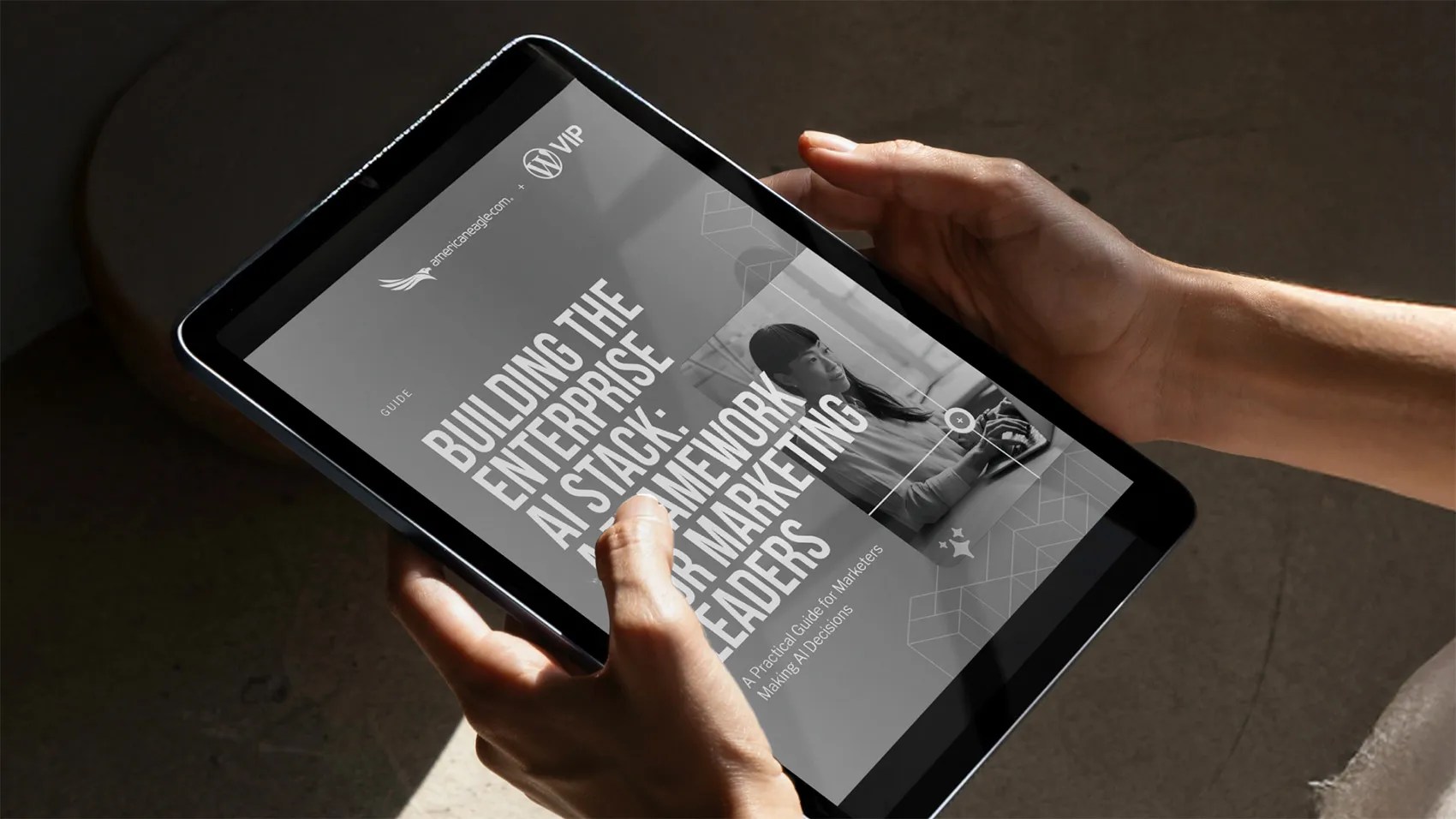
A new guide from WordPress VIP and Americaneagle.com, and what agencies can do with it.
Americaneagle.com is an Automattic for Agencies partner. They’ve been in digital for more than 30 years, have 700-plus people, and just co-published an enterprise guide with WordPress VIP entitled Building the Enterprise AI Stack: A Framework for Marketing Leaders.
It’s aimed at the enterprise marketing leaders who buy this kind of work. Agencies should read it anyway. Every problem it names is a project somebody is about to get hired for.
The Problem Isn’t Adoption Anymore
Enterprise teams aren’t struggling to adopt AI. They’re struggling to control what happens after.
McKinsey’s 2025 State of AI survey found 88% of organizations using AI in at least one function, and only about a third that had begun scaling it across the enterprise. SS&C Blue Prism’s 2025 Global Enterprise AI Survey puts it more starkly, finding that 69% of AI projects never reach live operational use, mostly for want of planning and governance.
Individually, the tools your clients bought work fine. The trouble is in the operation around them. Content volume is up while brand voice drifts across channels, personalization runs without access to real customer data, and nobody has decided who sets the rules.
For agencies, that changes the pitch. You’re selling coordination, and coordination takes a longer engagement than a feature build.
Generate, Compose, Customize
The guide sorts AI work into three modes, and the main thing they give you is vocabulary a client can use to say where they’re stuck.
Generate is out-of-the-box AI inside the CMS and the marketing tools. It delivers fast wins on isolated use cases, which is why most organizations start here and plenty of them stay. The symptoms show up later as inconsistent output across channels, duplicated effort across tools, and downstream teams spending more time correcting what the AI produced than benefiting from it.
Compose is connecting systems so AI can move across workflows. This is where teams try to put AI into practice, and where the guide says most strategies break. Integrations multiply faster than anyone assigns ownership for them, and the stack ends up more fragile than it started.
Customize is building AI against a client’s own workflows and proprietary data. It’s where the real differentiation comes from, and most teams hesitate because it costs more and takes longer.
Most organizations are running all three at once without noticing, which is why naming the modes out loud does so much work in a first conversation.
How to Sell Against Each Mode
Generate-stuck clients need an audit. The guide’s first recommendation is to find every place AI is already running across their tools and flag the overlap and redundancy. It’s a scoped, sellable engagement, and it usually turns up the follow-on work.
Compose-stuck clients need an owner. The guide is direct about this. Connect a few workflows that matter rather than everything at once. Define who owns each step. Build modular, API-first integrations instead of tightly coupled ones. Holding all of that together over time is retainer work, and an agency is usually better positioned for it than a stretched in-house team.
Customize-stuck clients need discipline. The advice is to pick one or two workflows that touch revenue, conversion, or customer experience directly, and leave the rest alone. It’s also how you keep a project small enough to ship.
Five Questions to Bring to Your Next Client Meeting
The guide closes with five questions for marketing teams to ask themselves. They work just as well pointed across the table:
- Where are you currently using AI across content and marketing workflows?
- Which workflows create the most friction today, and what did layering AI on top actually introduce?
- Where is out-of-the-box AI meeting the need, and where would customization create real differentiation?
- Do you have the governance and ownership models to scale this?
- What manual or duplicated work still exists despite the AI you’ve bought?
Question five does the most work, because the honest answer is usually longer than anyone expects.
What to Look for in the Platform Underneath
The last section covers platform readiness: governance and control, workflow consistency, composable integration, operational resilience, and content readiness. You can run it as a checklist against whatever a client is on today.
This is also where WordPress gives you an argument. Its content model is structured and governable, which is what both people and AI agents need from it, and the API-first architecture means nothing locks a client into a single pattern. It’s open source too, so a client can see exactly how their stack works.
WordPress VIP covers the enterprise end, with the governance controls and scale large organizations need. If a client has outgrown their current setup, you can refer them through Automattic for Agencies and earn commission on the deal.
Read it with a Client in Mind
Pick your most AI-confused account. Go through the guide with that account in front of you and mark where they sit in each of the three modes. Most of the time, that’s enough to build a proposal.


