


A field guide to what separates the agencies pulling ahead, and how to move up
We built this framework from conversations with WordPress agencies at WordCamp Asia 2026, run by Automattic for Agencies. Treat it as a field read rather than a statistical study. Use the ladder to locate yourself and decide your next move rather than as a census of the industry. The patterns held consistently enough across those conversations that we expect they’ll feel familiar. You’re the real test of that, though.
What separates agencies now is where AI lives
The debate about whether agencies should use AI is over. Nearly all of them do, in some form. The more useful question now is what separates the agencies getting value from AI from the ones who have simply added it to a few tasks.
At the agencies pulling ahead, AI know-how lives in the organization, not in a handful of individuals. In most agencies, it still sits with a few people. They work faster for it, but the agency around them hasn’t changed. In a smaller group, AI has become part of how the place runs: written down, owned, built into the work. Those agencies talk about AI completely differently, and they’re the ones turning it from a way for a few people to work faster into something the business owns.
This guide won’t tell you which tools to buy, since everyone can buy the same subscriptions. It’s about how work gets organized, which is what builds a lasting advantage.
The four-tier ladder: from individual habit to organizational capability
The ladder measures how far AI capability has moved from individuals into the organization. The middle is crowded and the top is thin. Climbing it is less about better tools and more about how the work is organized.
Picture your most AI-fluent person quitting tomorrow. How much of your AI capability leaves with them? The more the honest answer is “most of it”, the lower you sit on the ladder.
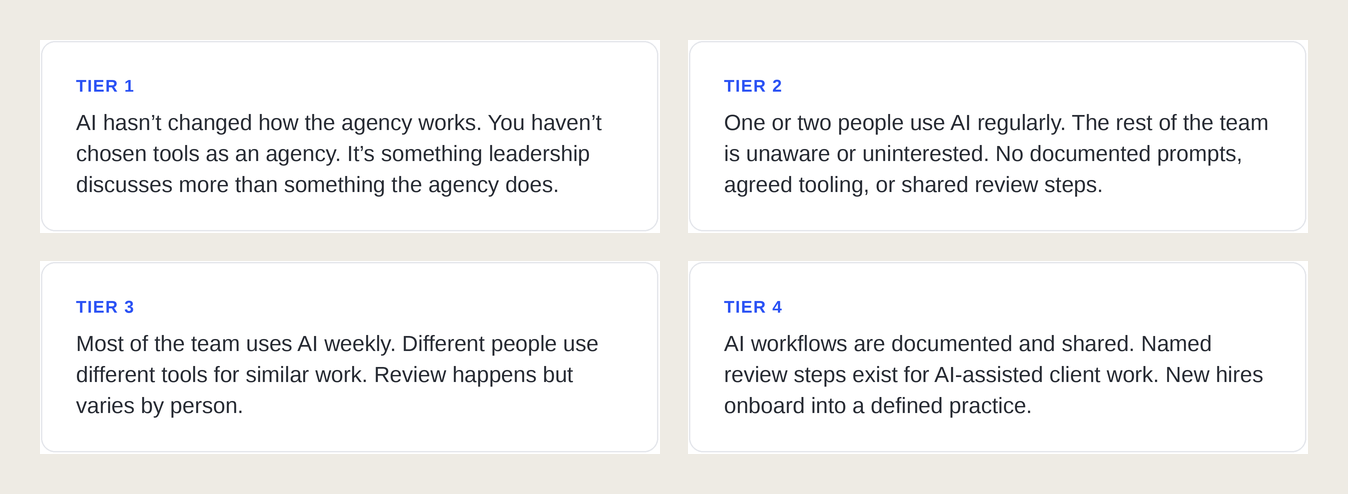
Tier 1: Individual and incidental. As an organization, the agency hasn’t adopted AI. A few people may use it on their own, but nothing about how the agency works has changed. Often aware and willing, but not yet moving as a team.
Tier 2: Concentrated. One or two power users, usually a developer or a writer, have built personal habits. The rest of the team is unaware or uninterested. The capability exists, but it lives in two people rather than in the agency.
Tier 3: Widespread but undocumented. The most common tier. Plenty of people use AI across plenty of workflows, but it all still lives in their heads rather than on paper. Different people use different tools for similar work, prompt quality varies, and review is informal. The agency uses AI heavily; it just hasn’t organized any of it.
Tier 4: Embedded. AI is built into how the agency works: documented prompts with named owners, codified workflows, named review steps. New hires onboard into a defined practice instead of working it out alone. Because the capability lives in the organization, it survives turnover.
Place yourself: which row sounds most like your agency?
Pick the one that fits best. If you’re between two tiers, choose the lower one. In our conversations, most agencies placed themselves a tier higher than their specifics warranted.
The quality and trust tension
The agencies getting the most out of AI often trusted it the least. The more seriously you use AI the more you see its variance, its subtle errors, its “that’s not quite what I meant” moments. Light users haven’t run into those yet, while heavy users have.
We don’t offer this as a law, only as the most useful way we found to think about it. Low trust usually means you’re paying attention. The agencies near the top of the ladder haven’t made their distrust go away; they’ve built workflows that contain it. Good review steps catch what AI gets wrong, which is exactly what frees a team to use it more. Instead of waiting to trust the AI, build the process that makes trust beside the point.
Five behaviors the top agencies tend to share
Five behaviors came up again and again among the agencies highest on the ladder. We’re describing what these agencies share, not claiming any single behavior is what made them succeed. Well-run agencies tend to do many things well at once. Still, all five are concrete, within reach of any agency, and they point in the same direction.
Five behaviors the top agencies share
Common among agencies highest on the ladder
1 They standardized before they scaled
Move AI from habits into documented team workflows.
Shared prompt libraries with named owners, standard processes for common jobs, review steps everyone follows. One power user builds something that works, someone writes it down and names it, and the agency rolls it out. The know-how ends up living in the agency rather than in one person’s head, so losing the person doesn’t mean losing the capability.
2 They aim AI at the work clients never see
Point AI at internal ops, not just delivery.
Most agencies use AI for the work clients do see. The agencies higher on the ladder also point it at the rest: internal documentation, SOPs, training material, hosting and monitoring, client reporting, internal search. AI on visible delivery makes delivery faster. AI on internal operations changes what it costs to run the whole agency, and that is where the gains quietly add up.
3 They keep a layered tool stack
Match the tool to the task, not loyalty to one.
They run a mix: general-purpose chatbots for broad reasoning and drafting, WordPress-native tools for work that benefits from platform integration, and specialist tools like coding assistants, design AIs, and analytics for the highest-value jobs. What marks them out is fluency across several tools rather than loyalty to a favorite.
4 They make review a step in the process
Build review in as a defined gate, not a gut feeling.
Instead of treating distrust as a reason to hold back, they build review in: an editor checks AI-generated content, a developer reviews AI-generated code, and a named QA gate stands between any work and the client. Review is a defined step rather than a gut feeling, and the person who reviews is never the person who drafted.
5 They’ve had the client conversation
Take on trust, privacy, IP and attribution head-on.
Client worries about AI don’t fade on their own. The agencies higher on the ladder take them on directly. They set disclosure protocols, write AI-usage clauses into their contracts, and turn a clear AI policy into a selling point. An agency that can say plainly how it uses AI, where it won’t, and how it checks the output comes across as more sophisticated than one that over-promises or ducks the question, especially with regulated or enterprise clients.
The playbook: four moves to climb a tier
This is roughly the order the embedded agencies followed to get where they are. We can’t promise a timeline, since that depends on your size, your team, and how hard you push, but running the plays in sequence makes each one easier than starting it from scratch. Each play fits inside a quarter.
Audit your tier honestly.
Use the self-assessment above to get a read on where you sit versus where you assume you sit. Knowing your starting point helps you focus the rest of the plays where they matter most.
Move AI into one behind-the-scenes workflow this quarter.
Pick one workflow clients don’t see, such as internal documentation, SOPs, training material, hosting alerts, or monthly reporting, and run a 90-day trial. Internal documentation is a common place to start, because it’s high-volume, low-risk, and the value grows as the library does.
Build the review process before you scale the tool.
Before rolling AI out more widely, write down what gets reviewed, who reviews it, and what review actually means. The review process is what lets you scale AI use without scaling AI variance.
Have the client conversation proactively.
Draft a position you can state clearly: where you use AI, where you don’t, what your review and quality controls look like, and what you’ll disclose. Setting it out on your own terms looks like confidence.
Run them in sequence. Plays 1 and 2 are about understanding where you are and pushing into a new workflow. Plays 3 and 4 are the operational layer that turns that new workflow into a repeatable capability. Re-run the self-assessment at the end of the cycle to see whether you’ve moved.
The agencies pulling ahead didn’t buy better AI
They moved it out of individual heads and into the organization: standardizing their workflows, applying AI to operations as well as client-facing work, and building review into the process. We won’t claim that climbing the ladder guarantees a healthier business. We will say it was the clearest line we saw between the agencies that feel in control of AI and the ones that feel run by it. The first move is small: name one owner, pick one workflow, and give it a quarter. That’s where every agency at the top of the ladder began.
Whether you’re scoping a starting point, packaging a service line, or answering a client’s AI questions, the Automattic for Agencies team can help. Reach us at partnerships@automattic.com.

 Automattic